 3ec4eafbc9
The theme system stores one flat background colour per element, so a rainbow
background can't be expressed as a preset alone. Add a small display hook:
when Pride is selected, displayClearBuf()/displayClearRows() paint the six
pride-flag stripes across the framebuffer instead of a flat fill (gated on a
flag only the Pride preset sets, and behind HAS_COLOURS so mono builds are
untouched). Non-selected menu rows draw text straight over the canvas, while
the title/header/notifications paint solid white boxes, so chrome stays
readable over the stripes; blue/violet are lightened slightly for black-text
contrast. Docs and changelog updated.

Co-Authored-By: Claude Fable 5 <noreply@anthropic.com>
6.8 KiB
FreeTRX
FreeTRX is a fork of the OpenGD77 firmware for DMR transceivers built around the STM32F405VGT MCU, AT1846S RF chip and HR-C6000 DMR chipset — the TYT MD-UV380 / Retevis RT-3S and Baofeng DM-1701 / Retevis RT-84.
It adds a number of UI and quality-of-life changes on top of OpenGD77 (segmented S-meter, 7-segment frequency font, screen dimming, an audio-mute function, DMR text messaging, colour theme presets, on-radio channel editing, and more).
📖 MANUAL.md is the full feature & usage guide — every feature is
tagged 🟢 [FreeTRX] (new/changed here) or ⚪ [OpenGD77] (inherited). See
CHANGELOG.md for the version history.
Screenshots
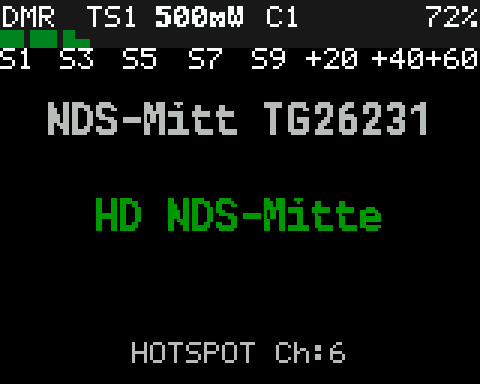
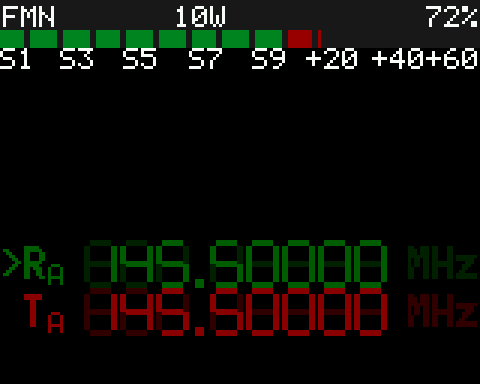
| Segmented S-meter & DMR call | 7-segment frequency display |
|---|---|
 |
 |
What's different from OpenGD77
FreeTRX keeps OpenGD77's core (DMR/FM, hotspot, CPS compatibility) and adds:
- Audio mute — new SK2 short-tap. A short tap of SK2 on the VFO/Channel screen toggles the speaker mute on and off. Turning the volume knob fully down counts as muted too. While muted, a bold "M" appears in the status bar (left of the battery) and the red LED flashes (0.5 s every 2 s). SK2's existing roles are unchanged: held as a modifier, extra-long-press for monitor/squelch-off, and — while a DMR QSO is on screen — a tap still sets the TX talkgroup to the incoming one.
- Segmented block S-meter with one block per S-level (S1–S9 green, S9+ red) and a scale label row (S1 S3 S5 S7 S9 / +20 +40 +60).
- 7-segment "LED" frequency font on the VFO and the SK1-held frequency view.
- Screen dimming — optionally dim the backlight to 100 / 50 / 30 / 15 % after inactivity (Auto backlight mode); new setting in Display Options.
- DMR text messages (SMS) — send and receive text messages on the radio, compatible with BrandMeister, hotspots and OEM radios. Compose on the keypad, inbox/sent boxes, quick-text templates, delivery confirmation and an incoming-message popup (see the manual for details).
- Theme presets — pick a colour theme on the radio: Custom (CPS-editable, default), BASIC 80s (Commodore 64), Terminal (green-on-black), Vertexic (amber/orange), Red, Neon 80s (multi-colour synthwave), or Pride (rainbow background). CPS edits only affect Custom.
- On-radio channel management — create and delete channels directly from the Channel quick menu, no PC/CPS required (see Managing channels).
- DMR reliability fix — resolves a hard-fault (freeze needing a battery pull) on the DMR path that affected recent self-built OpenGD77 revisions.
See CHANGELOG.md for the complete list.
Managing channels on the radio
FreeTRX can create and delete channels without a PC. Both actions live in the Channel quick menu — from the Channel screen, press the top (orange) button to open it, then scroll to the bottom:
- New channel — creates a blank 145.500 MHz FM channel in the first free slot, adds it to the current zone, and opens Channel Details so you can set the name, frequency, tones, and so on. Press the green key to save. The new channel is immediately selectable in the zone (no need to re-enter it).
- Delete Channel — deletes the currently-selected channel after a confirmation (green confirms, red cancels). It is also scrubbed from every zone that referenced it. The last remaining channel cannot be deleted, and channels locked read-only (e.g. APRS) are protected.
Back up your codeplug (via the CPS) before making bulk edits — these changes are written straight to the radio and there is no on-device undo.
Supported radios
This first iteration is developed for and tested only on the TYT MD-UV380 and Retevis RT-3S. No other radios are officially supported at this time.
If you have another radio that OpenGD77 supports (Baofeng DM-1701 / Retevis RT-84, MD-9600, MD-380, MD-2017, …) and would like to help test FreeTRX on it, that would be very welcome — please email Marcus, DK1DA at qsl@dk1da.de.
Upstream source
This fork is based on the official OpenGD77 source release R20260131
(source snapshot OpenGD77_MDUV380_DM1701_20260130):
The original OpenGD77 project README is preserved in
README.OpenGD77.md.
DMR / AMBE codec
As with OpenGD77, the source does not contain the AMBE codec required for DMR
audio. It is merged in from an official manufacturer firmware (V26.45) at flash
time by the firmware loader. See TOOLS.md.
Flashing
Pre-built firmware is attached to each
release: OpenMDUV380.bin for the
MD-UV380 / RT-3S, OpenDM1701.bin for the DM-1701 / RT-84. (Or build your own —
see below.)
- Enter firmware-update (DFU) mode: power the radio off, then power it on while holding PTT + SK1 (the button above PTT). The screen stays blank and the top LED glows steadily. Connect the USB cable.
- Flash with the helper (it applies the DMR codec donor and, optionally, a
secondary language):
./flash.sh -m MD-UV380 -f MDUV380_firmware/build/OpenMDUV380.bin
# DM-1701 / RT-84:
./flash.sh -m DM-1701  -f MDUV380_firmware/build/OpenDM1701.bin
DMR note: the firmware image is FM-only until the AMBE codec donor (the
official V26.45 manufacturer firmware) is merged in at flash time. Register it
once with ./flash.sh -s /path/to/official_V26.45.bin; the path is then
remembered. Full options, the DFU device list and the underlying loader are
documented in TOOLS.md.
Building & tools
See TOOLS.md for building in Docker
(./build-firmware.sh [MDUV380|DM1701], Arm GNU Toolchain 14), grabbing
screenshots, and building language files.
License
FreeTRX inherits the OpenGD77 license — a modified BSD 3-Clause license with
an additional non-commercial clause. It is not an OSI-approved
open-source license and is not GPL-compatible; commercial use is prohibited.
The code cannot be relicensed. See LICENSE.md.
Credits
OpenGD77 was originally conceived by Kai Ludwig, DG4KLU, with further
development led by Roger Clark, VK3KYY and assisted by Daniel
Caujolle-Bert, F1RMB, Alex DL4LEX, Colin G4EML and many other contributors.
All original copyrights are retained (see the source file headers and
README.OpenGD77.md).
FreeTRX fork maintained by Marcus, DK1DA.